Why Viscous Products Destroy Level Sensors
Level measurement in tanks storing heavy crude oil, bitumen blends, molasses, resins, adhesives, or polymer slurries presents a consistent problem: the product clings to everything it contacts. Float switches jam in the up position as product accumulates on the float body and cable. Capacitance probes develop a layer of product on the probe electrode that changes the capacitance reading independently of the actual liquid level — causing progressive drift that makes the measurement increasingly unreliable.
Even submersible pressure transmitters, which are typically reliable across a wide range of process applications, suffer in viscous service. Diaphragm faces fill with product that hardens over time, restricting diaphragm movement and causing zero shifts in the pressure reading. In heated tanks where viscous products are maintained at elevated temperatures to remain pumpable, thermal cycling exacerbates the buildup problem as product bakes onto sensor surfaces.
The operational result is predictable: operators lose confidence in automated level readings, resort to manual dipping or sight glass checks, and schedule frequent sensor cleaning shutdowns. In tanks storing flammable or toxic products, manual level checking creates additional hazard exposure. In tanks with limited access or elevated mounting points, frequent cleaning becomes a time-consuming maintenance burden.
The Non-Contact Approach
Non-contact radar level transmitters mount on a nozzle at the top of the tank and transmit microwave energy downward through the vapour space to the liquid surface. The signal reflects from the liquid surface and returns to the antenna. No part of the instrument contacts the liquid — the measurement is entirely non-invasive.
This architecture eliminates coating-related measurement errors by design. Whether the tank contains water, diesel, molasses, or bitumen, the radar signal interacts only with the vapour space and the liquid surface. The antenna face sits in the headspace above the product. Even if some product splashes or condenses onto the antenna face — which can occur during filling — the measurement is largely unaffected because modern FMCW (Frequency Modulated Continuous Wave) radar algorithms are designed to compensate for minor antenna coating.
FMCW Radar and Antenna Coating Compensation
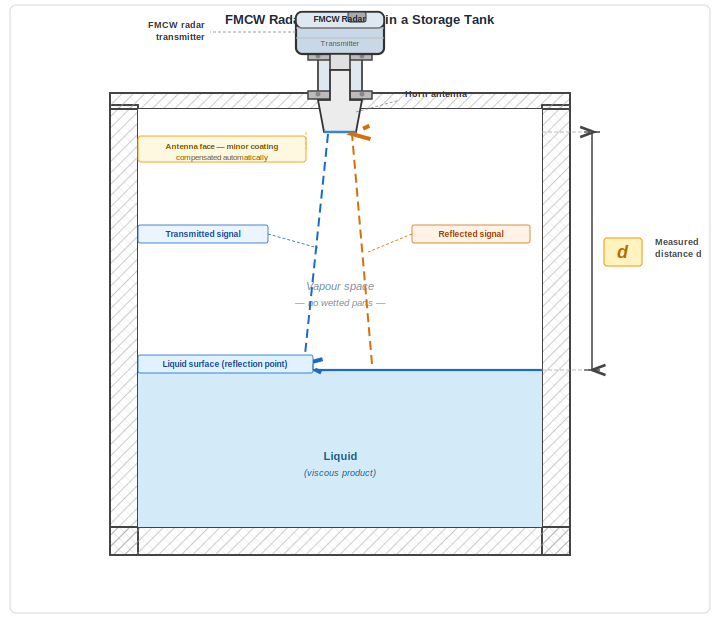
FMCW radar transmitters measure distance by continuously varying the transmitted frequency and comparing the transmitted and received signals to calculate the time of flight. The accuracy of this measurement depends on correctly identifying the reflection from the liquid surface, not from the antenna face or from internal tank structures.
Modern 80 GHz FMCW radar transmitters use advanced echo processing algorithms to distinguish the liquid surface reflection from other echoes — including the short-range echo from a coated antenna face. The transmitter monitors antenna coating as a diagnostic parameter: if the coating becomes severe enough to affect measurement, the transmitter generates an alert rather than silently drifting. This is a fundamentally different failure mode from a contact-based sensor, where coating causes silent measurement errors with no indication that the reading is compromised.
The 80 GHz frequency is also advantageous in viscous applications because the shorter wavelength (approximately 3.75mm) produces a narrower, more focused beam than lower-frequency radar (6 GHz or 26 GHz). The focused beam is less susceptible to false reflections from internal structures like heating coils, and it provides better performance at close ranges — useful in shallow tanks or in tanks where agitation keeps the surface turbulent.
Horn vs Parabolic Antennas for Viscous Service
For applications where product coating on the antenna is a significant concern — particularly open tanks where splashing during filling is expected, or heated tanks with heavy vapour condensation — the antenna geometry matters. Two options are typically appropriate:
PTFE horn antennas with a drop-shaped or flush-faced design minimise surface area exposed to the vapour space and are easy to wipe clean during periodic maintenance. The PTFE material is resistant to adhesion by most organic products and can be wiped clean without solvents in most cases.
Parabolic dish antennas provide maximum beam focus and are available in stainless steel or PTFE-lined versions. For highly viscous products in large tanks where a tightly focused beam is needed to avoid internal structure interference, the parabolic antenna is the higher-performance option, though it is more expensive and larger.
For most viscous liquid storage applications in the petroleum, chemical, and food processing sectors, a standard PTFE horn or polypropylene rod antenna provides adequate performance at a practical price point.
Applications and Limitations
Non-contact radar performs well across the full range of viscous liquid storage applications: fuel oil storage tanks, crude oil storage, polymer resin tanks, molasses silos, adhesive storage, and chemical intermediate storage. The technology is suitable for tanks from a few hundred litres to large atmospheric storage tanks hundreds of metres in diameter.
One application where non-contact radar requires care is agitated tanks with extremely turbulent surfaces — reactors under high-speed mixing, for example, or tanks with violent surface agitation. Turbulence creates multiple competing reflections that can confuse echo-processing algorithms. In these applications, guided wave radar (which measures along a probe that extends into the liquid, providing a stable reference regardless of surface turbulence) is often a better choice than free-space radar.
For standard viscous liquid storage, however — tanks without agitators, where the challenge is simply product coating rather than surface turbulence — non-contact radar is the most maintenance-friendly and operationally reliable solution available.
The Bottom Line
If your maintenance log includes recurring entries for cleaning, recalibrating, or replacing level sensors in viscous service, the root cause is contact-based measurement in an application that punishes sensor contact. Non-contact radar removes the contact and removes the problem. The investment in a quality FMCW radar transmitter typically pays back within the first couple of years through reduced maintenance, eliminated cleaning shutdowns, and the recovery of operator trust in automated level readings.