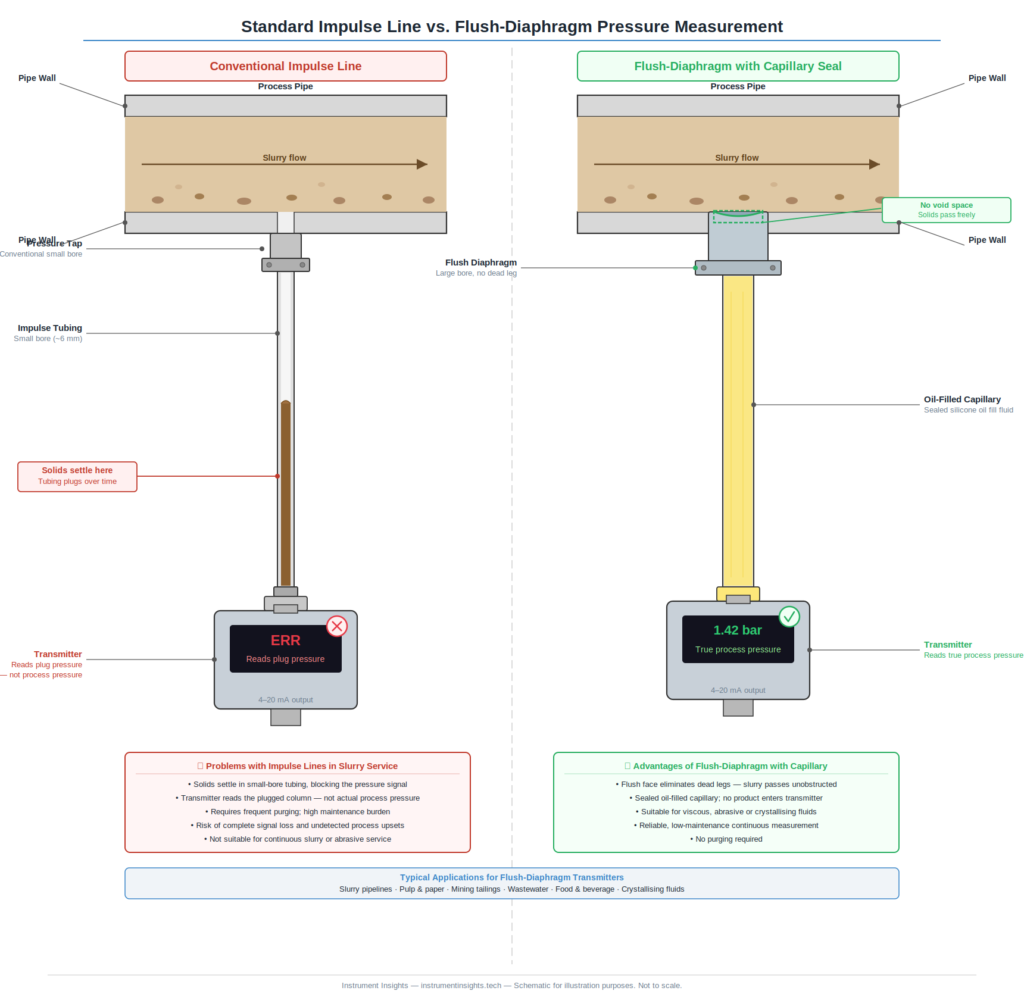
The Impulse Line Problem in Dirty Process Applications
Impulse lines are the small-bore tubing or pipe runs that connect a process pressure tap to a transmitter mounted away from the pipe or vessel. In clean fluid service — water, light hydrocarbons, clean steam — impulse lines work reliably. The fluid in the line transmits pressure faithfully to the transmitter’s sensing element, the reading is accurate, and the configuration requires minimal maintenance. It’s a simple, robust solution that has been standard practice for decades.
The assumption built into that design is that the fluid in the impulse line stays fluid. In slurry service, that assumption fails. Mining process slurries carrying fine ore particles, wastewater streams laden with suspended solids, paper pulp, mineral concentrates, and food processing byproducts all contain material that will settle, pack, and solidify in any void space where the flow velocity drops to near zero. An impulse line is exactly that kind of void space — a dead-ended tube where process fluid sits motionless while the main line flows past. Give it enough time and the right process, and the impulse line fills with solids.
The same failure mode occurs with highly viscous products. Heavy fuel oils, polymer solutions, and thick pastes don’t settle — they simply don’t transmit pressure through a filled-but-stagnant tube the way a low-viscosity fluid does. The hydraulic connection between the process and the transmitter is effectively broken, and the reading drifts or freezes at whatever value was last established before the line became packed.
How Plugging Creates Dangerous False Readings
The insidious quality of an impulse line plug is that it rarely announces itself cleanly. A broken transmitter goes to a fault condition that alarms. A plugged impulse line gives a reading that looks plausible — it may be close to the actual process pressure, or it may have frozen at a value from hours or days ago — but the control system sees a live signal and has no way to flag it as suspect. Operators and control loops act on that reading as if it were accurate.
In pump protection applications, this is genuinely dangerous. A pressure transmitter monitoring pump suction that reads a plausible but incorrect value can mask cavitation conditions or a developing suction blockage until mechanical damage occurs. In vessel level measurement using differential pressure — where a plugged low-side impulse line drives the indicated level toward full even as the vessel empties — operators can make decisions based on level data that is completely disconnected from reality. The signal looks healthy. The data is wrong. Nothing in the system tells anyone otherwise until something fails or a round of manual checks catches the discrepancy.
The maintenance response to chronic impulse line plugging is typically a combination of impulse line blowdown valves, heat tracing to keep viscous material mobile, and more frequent inspection rounds. These are all legitimate tactics, but they’re managing a fundamental mismatch between the measurement technology and the process. Every blowdown is a maintenance intervention that costs technician time and introduces a brief period of invalid data. In busy plants with many such measurement points, the cumulative burden is significant.
Flush-Diaphragm Pressure Transmitters — Eliminating the Void
The solution to impulse line plugging is to eliminate the impulse line entirely. Flush-diaphragm pressure transmitters mount directly at the process connection with a large-bore sensing diaphragm that sits flush with — or slightly recessed from — the inner wall of the pipe or vessel. There is no cavity, no tubing run, no void space where solids can settle. The process fluid contacts the diaphragm face directly, and the diaphragm transmits pressure through an oil-filled capillary system to the transmitter electronics mounted away from the process.
The oil-filled capillary is the key to the design. Because the signal path from process to transmitter is entirely filled with incompressible hydraulic fill fluid — typically silicone oil or a food-grade equivalent — there is no air space, no settling zone, and no mechanism for plugging. The capillary can be any length required to position the transmitter electronics in an accessible location away from heat, vibration, or physical hazard. Lengths of one to five meters are common; longer runs are possible with careful attention to temperature effects on the fill fluid volume.
The diaphragm face itself is sized substantially larger than the sensing diaphragm of a conventional transmitter. Where a standard transmitter might have a diaphragm 50 to 75 millimeters in diameter, a flush-mount slurry design may use a 150-millimeter or larger face — enough area to span across a full-bore process connection and ensure that nothing can bridge across and create a pocket behind the diaphragm. The process connection is typically a full-bore flanged fitting, bolted directly to a matching flange on the pipe or vessel nozzle, with no constriction at the process interface.
Diaphragm Material Selection for Abrasive Service
A flush diaphragm that sits in direct contact with an abrasive slurry faces wear that will eventually thin and fatigue the sensing element. Diaphragm material selection is therefore as important as the basic design choice to go flush-mount. Standard 316L stainless steel diaphragms, which perform well in corrosive chemical service, may last only weeks or months in high-velocity mineral slurries carrying hard particles — silica, iron ore, or alumina-rich process streams are particularly aggressive.
Hardened alloy diaphragms extend service life substantially. Hastelloy C-276 offers significantly better abrasion and corrosion resistance than 316L in acidic slurry service. For the most aggressive applications, ceramic diaphragm inserts — typically alumina or zirconia — provide hardness that metallic diaphragms cannot match. A ceramic face bonded to a metal carrier structure can outlast a stainless diaphragm by a factor of ten or more in the same service. The tradeoff is brittleness — ceramic diaphragms are vulnerable to impact loads and require careful handling during installation and maintenance.
Elastomeric diaphragm coverings are another option in applications where the abrasion mechanism is surface erosion rather than hard-particle impact. A thick PTFE or EPDM facing bonded to the metal diaphragm sacrifices some of the sharp, accurate response of a bare metal sensing element in exchange for a wear surface that can be replaced without replacing the entire instrument. This approach works well in applications where the solids are softer and the primary concern is chemical attack combined with mild abrasion.
Process-Specific Considerations — Mining, Wastewater, and Food
Mining and mineral processing applications represent the most demanding end of the slurry measurement spectrum. Ore slurries in grinding circuits, flotation feed lines, and concentrate thickeners combine high solids loadings — sometimes exceeding 60 percent by weight — with particle sizes that span from sub-micron clay fractions to coarse fragments several millimeters across. pH ranges from strongly acidic in sulfide ore processing to strongly alkaline in alumina refining. The combination of abrasion, corrosion, and process temperatures that can exceed 80°C demands the most robust diaphragm materials and the most careful attention to fill fluid selection.
Wastewater and municipal sludge applications are less aggressive in terms of particle hardness but introduce biological fouling as an additional concern. Sewage sludge, digester slurry, and thickened biosolids will coat any surface they contact with biological films that can eventually become rigid enough to impair diaphragm response. Flush diaphragms in wastewater service benefit from regular cleaning — either manual or through flush connections that allow temporary high-velocity water flow across the diaphragm face. Extended flush connections that position the transmitter away from confined-space vessel walls also improve maintainability in these environments.
Food processing applications involving tomato paste, fruit purees, starch slurries, or chocolate require hygienic flush-diaphragm designs with food-grade fill fluids and surface finishes that meet 3-A Sanitary Standards. The measurement challenge is the same — impulse lines plug in viscous or particulate-laden products — but the design requirements layer sanitary compliance on top of the basic functional requirements. Tri-clamp process connections, electropolished diaphragm faces, and FDA-compliant silicone fill fluids are standard in these services.
The Bottom Line
Plugged impulse lines in slurry and dirty process applications are not a maintenance inconvenience — they’re a measurement integrity failure that can drive unsafe process conditions, false alarms, and equipment damage. When the process contains solids, fibrous material, or high-viscosity products, the assumption that a conventional pressure tap with impulse tubing will provide reliable readings is an assumption that will eventually be proven wrong.
Flush-diaphragm transmitters and diaphragm seal systems exist specifically to solve this problem. By eliminating void spaces and placing the sensing element directly at the process boundary, they provide measurement that is inherently immune to the plugging failure mode. Matching the diaphragm material to the specific abrasion and corrosion conditions in the service — and selecting the right process connection design for the application — turns a chronically unreliable measurement point into one that holds up over long service intervals with minimal intervention. In challenging process services, that reliability is worth far more than the incremental cost of the right instrument.