Why Lift Stations Are Hard on Instruments
A lift station wetwell is not a clean process environment. It receives raw sewage from a gravity collection system — everything from grit and rags to hydrogen sulfide-laden septic flows from low-lying areas of the network. The liquid level fluctuates continuously with inflow, and pumps cycle on and off in response. The environment is corrosive, dirty, and often enclosed, creating an atmosphere that degrades electronics and sensor components steadily over time.
Standard level sensors — float switches, cable-suspended ultrasonic probes, basic pressure transducers — were not designed for this. Float switches foul with grease and rags. Ultrasonic sensors struggle with the turbulence and vapours present in active wetwells. Basic transducers with stainless diaphragms corrode in hydrogen sulfide environments faster than expected from the material data sheets.
When the level sensor fails or gives unreliable readings, the pump control logic starts making wrong decisions.
What Happens When Level Sensing Fails
Pump failures at lift stations typically follow one of two failure modes driven by poor level measurement:
Dry running. If the level sensor reads high when the actual wetwell is nearly empty, the pump control continues running the pump after the wetwell has drained. Centrifugal pumps operating dry lose their hydraulic cooling and lubrication, overheat, and fail — sometimes within minutes. Mechanical seal failures follow, turning a pump overhaul into a full replacement.
Overflow. If the sensor reads low when the wetwell is actually approaching capacity, the pump start signal comes too late. The wetwell overtops, raw sewage discharges to the environment, and the utility faces both a cleanup operation and a potential regulatory enforcement action. In combined sewer systems, this is often a CSO violation with associated fines and public reporting requirements.
Either outcome triggers an emergency callout — outside business hours, usually in bad weather, at a remote location. The cost is not just the repair; it’s the call-out rate, the emergency parts sourcing, and the lost production or service hours.
Specifying Sensors That Survive the Conditions
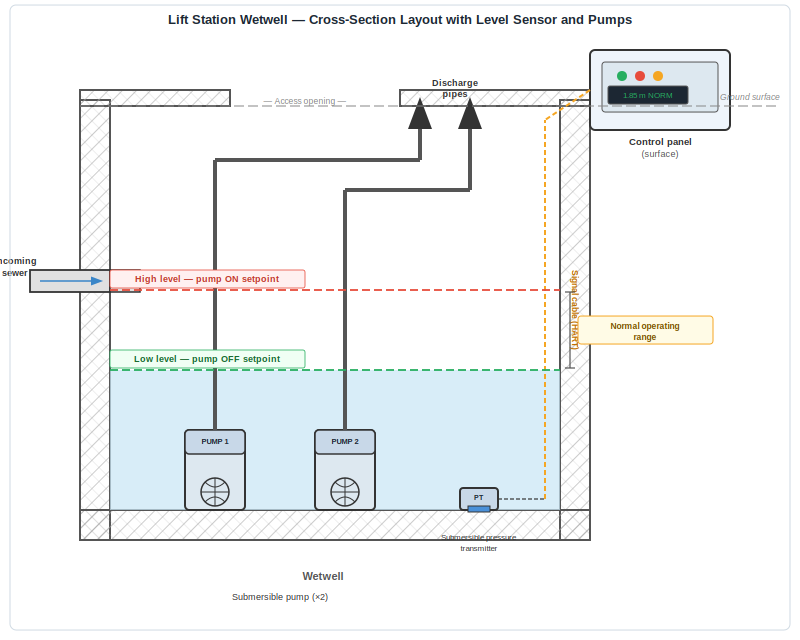
Submersible pressure transmitters are the most practical level measurement solution for most lift station applications. They mount at the bottom of the wetwell and measure hydrostatic pressure, which is directly proportional to the liquid level above. There are no moving parts, no cable suspensions to tangle in rags, and no surface-mounted sensor to be affected by the turbulence and vapours at the top of the wetwell.
The critical specification is the measuring cell material. Standard 316 stainless steel diaphragms are adequate for many wastewater applications, but in wetwells with consistently high hydrogen sulfide concentrations — common in septic systems and long-residence gravity sewers — ceramic measuring cells outperform stainless significantly. Ceramic is chemically inert to H₂S and resistant to the abrasive grit that slowly erodes metal diaphragms over time.
Cable materials matter equally. PTFE-jacketed cable resists chemical attack and is less prone to degradation from the range of substances found in wastewater. The cable entry point and any housing should be rated to at least IP68 for continuous submersion.
Smart Diagnostics and Remote Monitoring
The operational benefit of modern submersible transmitters goes beyond just measuring level. Instruments with HART communication allow the control system — or a remote monitoring platform — to read not just the level signal, but diagnostic data: sensor temperature, signal quality, and loop integrity. When the sensor is degrading, this shows up in the diagnostics before it shows up as a measurement failure.
For utilities managing a network of lift stations, this matters enormously. Instead of discovering a sensor failure when the pump fails at 2am, the maintenance team gets an alert that sensor diagnostics are deteriorating and schedules a proactive inspection during the day. That’s the difference between reactive maintenance and predictable operations.
Remote telemetry systems — whether SCADA-connected or standalone cellular units — that log level data continuously also build a record of normal pump cycle patterns. Deviations from the norm (shorter cycles, longer cycles, higher average levels) often indicate collection system problems — blockages, inflow and infiltration — before they become critical. The level sensor is no longer just a pump switch; it’s a diagnostic tool for the whole network.
The Bottom Line
Lift station reliability starts with level measurement that works in the conditions wastewater actually creates — not in a clean laboratory. Ceramic-celled submersible pressure transmitters with proper cable and housing specifications outlast standard alternatives in difficult wetwells, and their diagnostic capabilities reduce the emergency call-out cycle that consumes maintenance budgets in utilities that haven’t solved the sensor reliability problem.
The investment is straightforward: a quality submersible transmitter costs more upfront than a float switch, and a fraction of the cost of a single emergency pump replacement.