Where Water Utility Energy Bills Come From
For water and wastewater utilities, electrical energy is typically the single largest operating expense after labour. Pumping accounts for roughly 65–70% of a water utility’s total electrical energy consumption on average, according to the American Water Works Association (AWWA). In smaller utilities where pumping is the dominant electrical load, that share can be even higher.
The scale of this cost is easy to underestimate. A mid-sized utility running a network of lift stations, booster pumps, and service reservoir fill pumps may consume millions of kilowatt-hours annually just to move water from one point to another. Small efficiency improvements across that installed base translate directly into meaningful reductions in operating expenditure — without any reduction in service quality.
The question is why so much energy waste exists in the first place — and the answer often starts with level control strategy.
How Fixed-Setpoint Level Control Wastes Energy
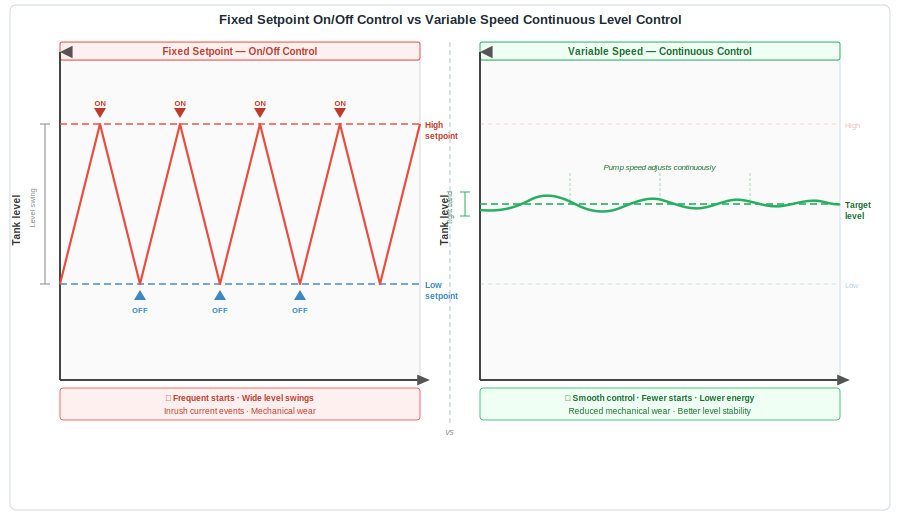
Traditional pump control in wet wells and storage tanks operates on a simple logic: when the level rises to a high setpoint, start the pump; when it falls to a low setpoint, stop the pump. This approach requires nothing more than a pair of level switches and a motor contactor.
The problems arise from how this strategy interacts with pump hydraulics and energy tariffs:
Short cycling and excess starts. Fixed-setpoint on/off control generates frequent pump starts and stops, particularly under varying inflow conditions. Each motor start draws several times the running current for a brief period (the inrush current), contributing to peak-demand charges on time-of-use tariffs. Beyond energy costs, frequent starts impose thermal and mechanical stress on motors and mechanical seals, reducing service life.
Operating outside the efficiency curve. Centrifugal pumps have a best efficiency point (BEP) defined by flow rate and head. When a pump runs at full speed in a system whose actual demand varies significantly — as all water systems do — it operates away from BEP for much of its runtime. The hydraulic inefficiency is real energy lost as heat in the pump casing rather than useful work done on the fluid.
Inability to respond to time-of-use tariffs. Many utilities are on electricity tariffs where the cost per kilowatt-hour varies significantly by time of day. Peak-demand periods (typically morning and evening) carry rates two to four times the off-peak rate. Fixed-setpoint control cannot shift pump operation toward cheaper overnight hours — it starts and stops pumps whenever the level dictates, regardless of electricity price.
What Continuous Level Measurement Enables
Replacing level switches with continuous level transmitters — 4–20 mA analogue output connected to a PLC or dedicated pump controller — transforms the available control strategies.
With continuous level data, the control system can:
Modulate pump speed in real time. A variable speed drive (VSD, also called a variable frequency drive or VFD) adjusts motor speed in response to actual level, maintaining a target level rather than swinging between high and low setpoints. The pump operates closer to its BEP for longer periods, reducing hydraulic losses. The affinity laws for centrifugal pumps state that power consumption varies with the cube of speed — reducing pump speed by just 20% reduces power consumption by approximately 49%. This is a large lever.
Implement time-of-use tariff optimisation. With knowledge of both the current level and the current electricity tariff period, the control system can pre-fill tanks or reservoirs during off-peak hours and coast on stored volume during peak tariff periods. This load-shifting strategy requires continuous level visibility to plan and execute safely — a pair of level switches cannot provide it.
Eliminate unnecessary short cycling. Continuous proportional control produces smooth level profiles with fewer discrete motor transitions, reducing inrush current events and the associated demand charges.
Realistic Energy Savings in Practice
Utilities implementing combined continuous level measurement and variable-speed pump control consistently report energy savings in the range of 15–30% on their pumping costs, depending on the starting point. The variation reflects how far from optimal the original fixed-setpoint control was — systems with poor setpoint spacing and frequent cycling show the largest gains.
A case often cited in AWWA literature involves distribution system booster stations: replacing fixed-speed pumps on level-switch control with variable-speed units on continuous level feedback reduced station energy consumption by approximately 20%, with the investment recovered within two to three years through reduced energy costs alone. Motor maintenance costs also fell as a secondary benefit of reduced start frequency.
The technology to achieve these savings is not new or experimental. Submersible pressure transmitters, non-contact radar level sensors, and VSDs are all mature, commercially available products available from multiple manufacturers. The barrier is often simply awareness that the level sensor is the starting point of the optimisation chain.
Integration Considerations
For utilities looking to implement this approach, the integration pathway is straightforward. Most modern PLCs and SCADA systems accept 4–20 mA or HART-enabled level inputs natively. VSD manufacturers provide application notes for wet well level control specifically. The key implementation considerations are:
Level sensor selection. In wet wells with rags, grit, and hydrogen sulfide, submersible pressure transmitters with ceramic measuring cells outperform ultrasonic sensors and float switches for long-term reliability. The continuous output is essential — a level switch cannot feed a VSD control algorithm.
Setpoint and band configuration. The VSD control algorithm requires a target level setpoint and a control band. The band must be sized to provide enough buffer volume for the pump to run efficiently without excessive cycling at the limits.
Alarm integrity. Upgrading from switches to transmitters for control does not eliminate the need for independent high-level and low-level alarms. These should be maintained as separate, hardwired protection layers, not replaced by software alarms derived from the same transmitter signal used for pump control.
The Bottom Line
In a sector where energy is a major operating cost and budgets are under constant pressure, the level sensor is a surprisingly high-leverage starting point for efficiency improvement. Moving from reactive on/off pump control driven by level switches to proportional variable-speed control driven by continuous level measurement is one of the most reliable paths to measurable, sustained reductions in pumping energy costs — without compromising reliability or service levels.
The sensor is where the data starts. Everything the control system does downstream is only as good as what it can measure.