Overfill as a Leading Cause of Tank Spills
Aboveground storage tanks at fuel terminals, chemical plants, and refineries represent a significant environmental risk when level monitoring fails. The US Environmental Protection Agency (EPA) SPCC (Spill Prevention, Control, and Countermeasure) rule, which governs facilities with aboveground oil storage above certain thresholds, identifies overfill as a leading cause of oil discharges from storage tank facilities. Tank overfill incidents range from minor spills contained within the berm to major releases with significant environmental and financial consequences.
The pattern of overfill incidents is consistent across industries: a level switch failed without detection, an operator missed a high-level alarm, or the primary level monitoring system’s high-level alarm was disabled, bypassed, or set incorrectly. In many cases, the investigation reveals that the facility had a single point of protection — if that one device failed, nothing stood between normal operation and overflow.
API Standard 2350 — the American Petroleum Institute’s standard for overfill prevention for petroleum storage tanks — specifically requires that overfill prevention systems include independent high-level alarms separate from the primary tank gauging system, and in many cases, automatic shutdown capability. The logic is straightforward: the primary level measurement system and the overfill protection system should not share a common failure mode.
Why Independent Protection Matters
In a typical tank farm, the primary level measurement device — a radar transmitter, a guided wave radar, or a servo gauge — provides the continuous level reading displayed in the control room and used for inventory management. This device generates a high-level alarm when the level reaches a defined setpoint. In many older installations, this is the only automated protection against overfill.
The problem is that this single device is both the measurement system and the protection system simultaneously. If the transmitter develops a fault — impulse line blockage causing a frozen reading, a calibration drift that makes it read low, or an electronic failure — the measurement fails and the protection fails at the same moment. The control room operator sees a level reading that appears normal and receives no alarm, while the tank continues filling.
An independent high-high level switch, installed on a separate nozzle at a higher elevation than the high-level alarm setpoint of the primary gauge, closes this gap. The switch uses a different technology from the primary transmitter (a float switch, a vibrating fork, or a guided wave radar point level sensor) and connects to a separate alarm system or directly to a safety shutdown function. Even if the primary transmitter fails completely, the independent switch provides a last line of automated defence.
Technology Options for Independent High-Level Switches
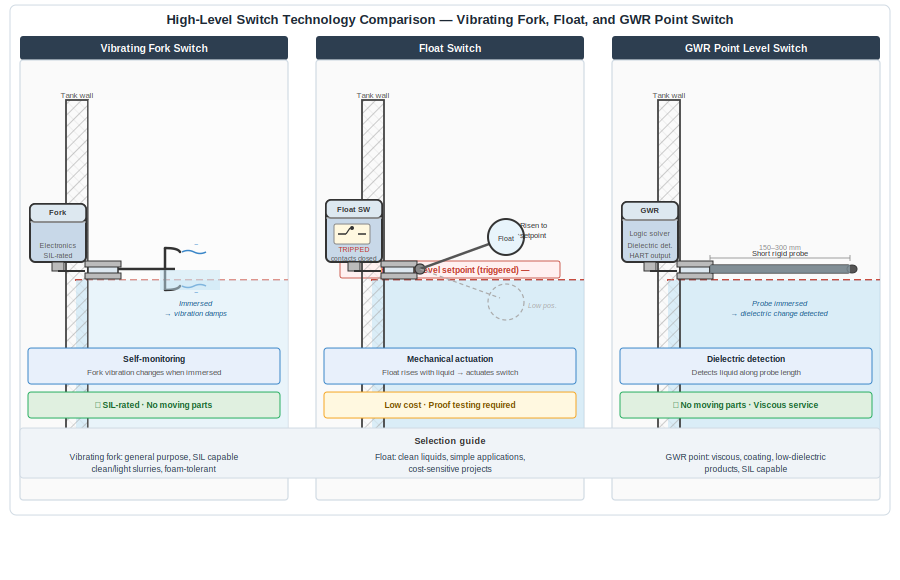
Several point level detection technologies are used for independent overfill protection. The appropriate choice depends on the product stored and the application requirements:
Vibrating fork (tuning fork) switches are among the most common choices for overfill protection in liquid service. The fork vibrates at its natural frequency; when immersed in liquid, the damping effect changes the frequency, and the electronics detect this change and change the output state. There are no moving parts (unlike float switches), and the device self-tests its vibration continuously — detecting faults including loss of vibration caused by corrosion or coating. SIL-certified versions are available from multiple manufacturers with documented dangerous failure rates suitable for SIL 1 and SIL 2 safety functions.
Float-operated switches are mechanically simple and inexpensive. A float rises with the liquid level and mechanically actuates a switch at the defined setpoint. The limitation in overfill protection service is that floats can stick in the down position due to product coating, corrosion, or mechanical binding — producing a dangerous undetected failure mode where the switch would not actuate even if the tank overfilled. Regular proof testing is essential for float switches in safety-critical applications.
Guided wave radar point level switches provide no-moving-parts detection with self-diagnostics. They detect the liquid surface along a short probe and are unaffected by product coating or build-up in the same way floats can be. For products that are viscous, sticky, or that form deposits, GWR point switches are more reliable than floats in long-term service.
SIL Certification and Proof Testing
IEC 61511 — the functional safety standard for the process industry — requires that safety instrumented functions (including overfill protection) be designed to an appropriate Safety Integrity Level. For aboveground storage tank overfill protection at typical petroleum terminals, SIL 1 is commonly the required level, though high-consequence locations (large tanks near waterways, urban areas, or with significant environmental sensitivity) may warrant SIL 2.
SIL certification of the high-level switch provides documented data on its dangerous failure rate and diagnostic coverage — the parameters needed to calculate whether the achieved SIL of the overall protection system meets the target. This calculation is part of the safety lifecycle documentation required by IEC 61511 and expected by regulators and insurers.
Proof testing is required at defined intervals to verify that the switch will actually actuate when the liquid reaches the setpoint. For float switches, this means physically verifying float movement and switch actuation. For electronic switches (vibrating fork, GWR), the transmitter’s self-diagnostics verify internal health continuously, but functional testing — verifying that the device correctly detects liquid at the setpoint — remains a requirement at the specified proof test interval.
Cost Perspective
The cost of a quality SIL-certified high-high level switch, installation, and integration into an independent alarm or shutdown circuit is a few thousand pounds or dollars per tank — the exact amount varying with the technology selected and the complexity of the shutdown logic. When compared with the cost of a single overfill incident — cleanup costs, regulatory fines, potential enforcement action under EPA SPCC rules, reputational damage, and possible business interruption — the investment is economically compelling.
API 2350 notes that the petroleum industry has observed that many overfill incidents occur during tank filling operations when operator attention is divided. Automated independent protection does not rely on an operator catching an alarm at the right moment — it acts independently of operator response, providing consistent protection regardless of workload or circumstances.
The Bottom Line
Independent high-level protection for storage tanks is not a gold-plating exercise — it is recognised best practice codified in API 2350 and required under functional safety principles for any installation where an overfill event has significant consequences. A single-point protection system that shares its primary level measurement function with its safety function is a known risk that independent switching eliminates.
The technology is available, the standards are clear, and the cost is low relative to the risk it mitigates. Independent high-high level protection belongs on every storage tank where an overfill matters.