The Problem With Contact Sensors in Corrosive Media
If you’ve worked with corrosive chemical storage; concentrated sulfuric acid, sodium hydroxide, hydrofluoric acid, aggressive solvents; you already know the maintenance cycle. Standard stainless steel sensors pit and fail within months. Ceramic diaphragms crack under thermal cycling. Even PTFE-coated probes eventually break down when exposed to strong oxidising acids or certain chlorinated solvents.
The result is a rotating roster of failed sensors, unreliable readings, and constant replacement costs. Worse, when a sensor fails mid-measurement, operators lose visibility into tank inventory. That’s when overflows happen, or when a tank runs dry and damages downstream equipment.
The material selection game; Hastelloy, tantalum, PVDF; buys time, but no wetted material is universally corrosion-proof. Sooner or later, the process wins.
Eliminating Contact Entirely
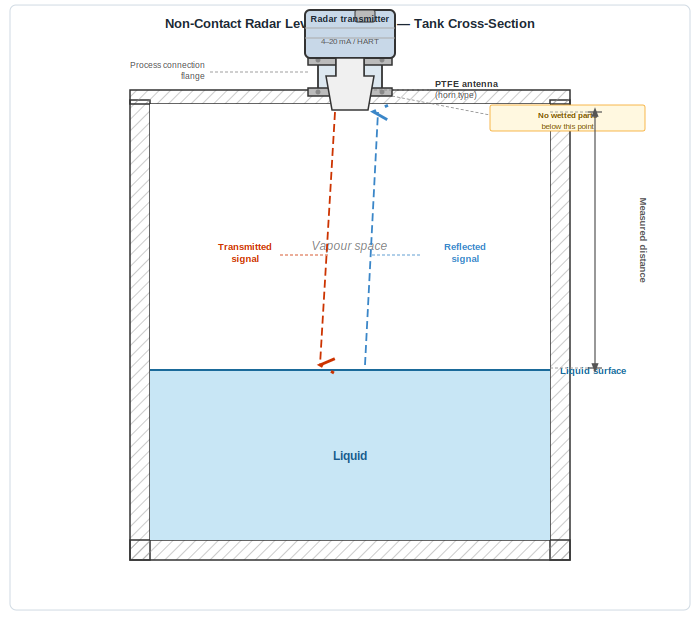
Non-contact radar level transmitters solve the corrosion problem at the source. The sensor mounts above the liquid on a nozzle at the top of the tank, and microwave signals travel through the vapour space to the liquid surface and back. The liquid never touches the antenna.
Modern FMCW (Frequency Modulated Continuous Wave) radar transmitters operate at 80 GHz, giving a focused beam that cuts through aggressive vapours, condensation, and even steam without signal degradation. The antenna assembly; typically PTFE or polypropylene; sits in the vapour space and sees nothing more corrosive than the fumes above the liquid. That’s a far gentler environment than full immersion in concentrated acid.
In a 20,000-litre caustic soda storage tank at 50°C, for example, a non-contact radar transmitter will typically run for years without intervention. There are no diaphragms to inspect, no coatings to monitor, and no scheduled sensor replacements to plan around.
What About Aggressive Vapours?
A common concern is whether vapours from highly aggressive media; HCl fumes, solvent vapours, chlorine off-gassing; will degrade the antenna over time. In practice, this is rarely an issue with properly specified PTFE or polypropylene antenna materials. The antenna face may accumulate light condensate or residue, but radar is tolerant of minor coating on the antenna face. Most modern transmitters include automatic compensation for antenna coating, maintaining measurement accuracy even as minor buildup occurs.
For particularly aggressive vapour environments, enclosed versions with process seals and purge connections are available. The transmitter electronics always remain isolated from the process; the only component exposed to vapours is the chemically resistant antenna face.
Practical Considerations for Installation
Non-contact radar does require a clear line of sight to the liquid surface. Avoid mounting directly above internal structures like heating coils, agitators, or inlet pipes; the radar beam will reflect off these and generate false echoes. Mount the sensor in a quiet zone, at least 200–300mm from the tank wall, and angle slightly off-centre if there are internal obstacles.
For tanks with very turbulent surfaces (e.g., agitated tanks or tanks with violent chemical reactions occurring), guided-wave radar or submersed pressure transmitters using appropriate wetted materials may be more appropriate. But for standard storage of aggressive liquids, non-contact radar is the most maintenance-friendly option available.
Non-contact radar is reliable by design, but installation errors are common enough to address explicitly. The most frequent mistake is using an undersized nozzle standoff. Most radar transmitters require a minimum nozzle length; typically 100mm or more; to prevent the antenna from sitting inside the nozzle bore. An antenna flush with or recessed into a nozzle will generate a strong false echo from the nozzle opening that can cause the transmitter to lock onto the wrong target. Always check the minimum nozzle length specification before ordering, and verify it against your actual nozzle geometry on site.
Frequently Asked Questions
Can non-contact radar measure through a fibreglass or plastic tank roof without a nozzle? Yes, modern radar transmitters, including 80 GHz units, pass their microwave signal through plastic and fibreglass with minimal attenuation. This makes nozzle-free installation practical on many plastic and GRP chemical storage tanks, which is particularly useful when cutting a nozzle would require vessel entry or hot work. The limitation is metal: radar cannot penetrate metal tank walls or roofs, so a top-entry nozzle that opens into the vapour space is required on steel vessels. For plastic or fibreglass tanks, verify with the manufacturer that the specific wall thickness and any internal lining materials are compatible; very thick walls or certain composite laminates can attenuate the signal enough to require closer evaluation.
How does foam on the liquid surface affect radar measurement? Foam is a challenge regardless of type, but the failure mode differs. Conductive foams; generated by caustic soda, acids, or conductive process liquids; reflect radar well, but the transmitter reads the top of the foam layer rather than the liquid surface below it. If the foam layer is thick or variable, the displayed level will be wrong even though the signal quality looks fine. Non-conductive foams from solvents or surfactants tend to absorb or scatter the signal and can cause signal loss or erratic readings. Modern 80 GHz transmitters with advanced echo processing handle light foam better than older lower-frequency units, but dense foam of either type is a difficult application. If significant foam is expected, test the specific transmitter’s echo processing under real process conditions before committing to the installation.
What is the minimum measurable level with a non-contact radar transmitter? Every radar transmitter has a blanking distance; a zone immediately below the antenna face where the transmitted and received signals overlap and measurements cannot be taken. On most industrial transmitters this is 100–500mm depending on frequency and antenna design. When specifying a transmitter for a tank where level must be measured close to the bottom, verify that the blanking distance plus the nozzle standoff does not push the minimum measurable point higher than the process requires. For 80 GHz transmitters with horn antennas, blanking distances tend to be shorter than on older lower-frequency units, which is one practical advantage of the higher frequency.
Common Mistakes to Avoid
Non-contact radar is reliable by design, but installation errors are common enough to address explicitly. The most frequent mistake is using an undersized nozzle standoff. Most radar transmitters require a minimum nozzle length; typically 100mm or more; to prevent the antenna from sitting inside the nozzle bore. An antenna flush with or recessed into a nozzle will generate a strong false echo from the nozzle opening that can cause the transmitter to lock onto the wrong target. Always check the minimum nozzle length specification before ordering, and verify it against your actual nozzle geometry on site.
A second common error is mounting the transmitter directly above internal obstacles without mapping them out. The radar beam has a defined cone angle; typically 3° to 10° depending on frequency and antenna size. At 80 GHz with a horn antenna the beam is narrow, but it still widens with distance. A heating coil or agitator blade two metres below the transmitter can fall within the beam and return a stronger echo than the liquid surface. Use the transmitter’s false echo suppression function to mark and suppress these reflections after installation; and document which echoes are suppressed so a future technician doesn’t clear the suppression map during troubleshooting.
Finally, verify the dielectric constant of the liquid before specifying radar for the application. Aqueous and conductive liquids; acids, caustics, water-based solutions; have dielectric constants well above 10, and radar works excellently on these. Some hydrocarbon solvents used in chemical processes have dielectric constants below 2, which produces very weak reflections. A transmitter rated to a minimum dielectric of 1.5 may struggle with a low-dielectric solvent in practice, particularly if foam is present at the surface. Check the process fluid’s dielectric constant against the transmitter’s minimum specification before committing to the technology.
The Bottom Line
If you’re replacing contact-based level sensors in corrosive chemical tanks more than once every two years, non-contact radar deserves a serious look. The upfront cost is higher than a basic float switch or differential pressure cell, but the elimination of replacement cycles, unplanned downtime, and corrosion-related measurement errors pays back quickly; typically within the first 12–18 months in high-maintenance corrosive applications.
No wetted parts means no corrosion. It’s a straightforward trade-off that makes sense in any application where the process media is winning the battle against your sensors.