The Offshore Environment — What Makes It Different
An offshore production platform is not a harsher version of an onshore facility — it is a fundamentally different operating environment that defeats assumptions that hold perfectly well on land. Offshore tank gauging must function under conditions that would be considered exceptional on a refinery and are simply routine at sea: continuous vessel motion from wave action and swells, salt-laden air that corrodes unprotected metal surfaces in months rather than years, temperature swings of 40 degrees Celsius between a cold North Sea night and the heat of a process deck in summer, and maintenance access windows that may be weeks or months apart rather than days.
The stakes attached to accurate level measurement offshore are also different. Custody transfer on an offshore facility — the fiscal measurement of hydrocarbons transferred from a production platform to an offtake tanker — directly determines the revenue recognized for every barrel produced. An error of half a percent on a 500,000-barrel transfer represents a discrepancy worth hundreds of thousands of dollars. Multiply that error across a year of production and the financial impact is material. This is not a utility measurement where a few tenths of a percent of inaccuracy is acceptable. It is a fiscal measurement held to the same standards as a laboratory balance.
Ballast management adds a second dimension of criticality. Offshore platforms and floating production units maintain stability through active ballast management — redistributing seawater between ballast tanks to counteract the weight of stored cargo, produced fluid, and equipment loads. Inaccurate tank level data in a ballast management system is not just a process inconvenience. It is a structural safety issue with consequences that extend beyond instrumentation and into naval architecture.
Why Standard Level Technologies Fail Offshore
The level measurement technologies that perform reliably in onshore tanks struggle or fail entirely in the offshore environment. Float-and-tape gauges, the simplest and most common level measurement method in fixed-roof storage tanks, rely on a float that sits at the liquid surface and rises and falls with it. In rough seas, the liquid surface is not stationary — it oscillates with the motion of the vessel. The float and its guide mechanism experience continuous mechanical cycling that accelerates wear and eventually causes binding. In extreme motion, the float may not track the liquid surface accurately at all.
Capacitance probes are sensitive to the dielectric properties of the liquid, which makes them suitable for water and clean hydrocarbons in controlled conditions. Offshore tanks routinely contain hydrocarbon blends whose composition varies with the producing reservoir, water cuts that change over time, and emulsified fluids at the water-oil interface. All of these variables affect the dielectric constant and introduce measurement error that is difficult to compensate for without continuous recalibration.
Ultrasonic level sensors transmit a sound pulse from the top of the tank and measure the time of flight to the liquid surface. They are widely used onshore and work well in clean tanks with predictable vapor spaces. Offshore cargo and production tanks often contain hydrocarbon vapors, inert gas blankets, or steam heating that attenuates the ultrasonic pulse or introduces false reflections. The continuous motion of the vessel also means the angle of incidence between the sensor and the liquid surface is never constant, affecting signal quality in ways that are difficult to characterize in a fixed installation.
Servo-Operated Tank Gauging — How It Works
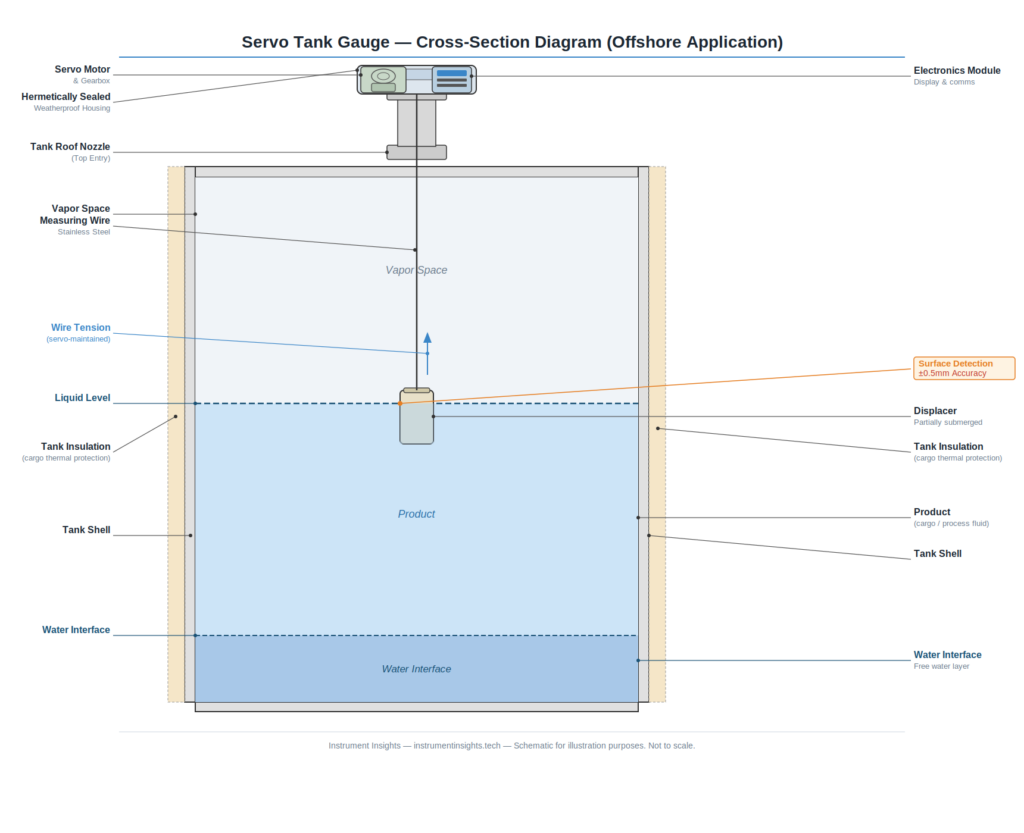
A servo-operated tank gauge measures liquid level through a fundamentally different physical principle than any of the technologies described above. A small cylindrical displacer — typically 200 to 260 grams — hangs from a fine stainless steel measuring wire that is wound on a precision drum driven by a servo motor. The servo motor continuously adjusts the wire length to keep the displacer at the liquid-vapor interface, where the buoyancy force acting on the partially submerged displacer creates a specific tension on the wire. A precision force sensor in the gauge head measures that tension and drives the servo motor to maintain it at a constant value. The drum position — and therefore the displacer position — is tracked by a precision encoder that reports level to within 0.5mm.
This design has several properties that make it particularly well suited to the offshore environment. The servo motor compensates for vessel motion continuously and automatically — as the liquid surface moves with the platform’s pitch and roll, the servo drives the displacer to follow it, maintaining the constant buoyancy force regardless of surface position. The measurement is inherently immune to vapor space composition because the gauge is not measuring time of flight through vapor — it is measuring the physical position of a displacer at the liquid interface.
The hermetically sealed housing that encloses the servo motor, drum, encoder, and electronics is critical to longevity in the marine atmosphere. Salt spray and humidity that would corrode a standard industrial enclosure within a maintenance cycle are excluded completely from the precision mechanism inside. Properly maintained, a servo gauge in a marine installation can deliver consistent accuracy for fifteen to twenty years — an important consideration when maintenance shutdowns are expensive and infrequent.
Modern servo gauges also measure the water-oil interface level by running the displacer through the liquid phase to the water layer below, where the change in buoyancy force precisely locates the interface position. This capability is essential for accurate net oil volume calculations and for managing water disposal in production tanks.
Custody Transfer Accuracy Requirements — API MPMS Chapter 17
The standard that governs custody transfer measurement on offshore installations is API Manual of Petroleum Measurement Standards Chapter 17, which specifies requirements for tank measurement systems used in marine terminal and offshore loading operations. Chapter 17 establishes the accuracy requirements for level measurement, temperature measurement, and the calculation methods used to convert observed quantities to net standard volume at reference conditions.
For a custody transfer application, Chapter 17 requires level measurement accuracy of 1mm or better under static conditions, with provisions for dynamic correction during loading operations when the vessel is in motion. The 0.5mm accuracy delivered by a properly calibrated servo gauge provides the margin required to meet this specification even with some degradation over the calibration interval. Temperature measurement must be accurate to within 0.1 degrees Celsius per API MPMS Chapter 7 (Temperature Determination), typically requiring multiple temperature sensors distributed vertically through the tank to capture stratification effects.
The calculation chain from raw measurements to net standard volume is specified in detail by API Chapter 11, which defines the correction factors for temperature and pressure effects on liquid density. The custody transfer computer — the system that applies these corrections and generates the transfer tickets — must be auditable and tamper-evident. In a fiscal metering context, both the buyer and seller have financial interests in the measurement, and the calculation methodology must be transparent and independently verifiable to satisfy both parties and the regulatory authority.
Building a Complete Custody Transfer Package
Tank level alone is not sufficient for custody transfer. Accurate fiscal metering requires a complete package of measurements and calculations that converts tank level into a net standard volume figure that both the operator and the customer can independently verify. The servo gauge provides the primary level measurement, but it works within a system that includes several other critical components.
Temperature measurement throughout the liquid column is required because hydrocarbon density is strongly temperature-dependent. A tank of crude oil that reads 10 meters of level at 40 degrees Celsius contains significantly less mass than the same 10 meters at 20 degrees Celsius. Multiple resistance temperature detectors distributed through the tank at known elevations measure the temperature profile, and the custody transfer computer integrates this profile to calculate a mean observed temperature for the density correction.
Water content measurement is the second essential element. The gross liquid volume in a production tank includes both oil and produced water, and the customer is buying oil — not the mixture. Water-cut analyzers measure the fraction of water in the produced stream continuously, and sampling systems collect representative samples for laboratory analysis that confirms the online analyzer’s readings. The combination of these measurements with the servo gauge level data and temperature correction produces the net standard volume of oil transferred — the number that appears on the custody transfer ticket and determines the revenue recognized for the transaction.
Vapor pressure measurement completes the package for volatile crude oils, allowing the calculation of a vapor pressure correction factor that accounts for the volume of light ends lost to evaporation between production and transfer. For some crude grades, this correction is small. For high-GOR (gas-oil ratio) crudes, it is significant and must be applied correctly to avoid systematically short-changing the producer or the customer.
The Bottom Line
Offshore tank gauging for custody transfer is one of the most demanding instrumentation applications in the process industries. The environment attacks conventional level technologies through corrosion, motion, and vapor interference. The accuracy requirements are set by financial and regulatory standards that leave no room for the kind of measurement uncertainty that is acceptable in process control applications. And the consequences of failure — revenue disputes, regulatory penalties, production shutdowns, and in the extreme case of ballast mismanagement, structural safety incidents — are severe enough to justify the investment in purpose-built measurement systems.
Servo-operated tank gauges, combined with distributed temperature measurement, water-cut analyzers, and API MPMS-compliant calculation software, represent the engineering solution that the offshore custody transfer problem demands. These are not premium options in a cost-benefit analysis — they are the minimum specification for a measurement system that meets the legal and commercial obligations of offshore hydrocarbon production. Getting the measurement right from the beginning is far less expensive than disputing the results afterward.