The Overcorrection Problem
Here’s a pattern that plays out in plants everywhere: a level sensor is slightly inaccurate; maybe 5% of span due to calibration drift, coating on the sensor face, or a measurement technology that struggles with the process conditions. The DCS reads 60% when the tank is actually at 65%. Operators notice that actual levels don’t match what they expect based on flow rates and batch volumes. Trust in the instrument erodes.
The response is rational: run the pumps a bit longer, keep the tanks a bit fuller, add a buffer. The control system’s setpoints get nudged conservatively. What this looks like in practice is pumps running against partially closed valves, tanks cycling between 80% and 95% instead of 50% and 75%, and variable frequency drives that never throttle down to their efficient operating range because the control system doesn’t trust its own feedback.
The energy penalty for this is real and measurable. Energy efficiency assessments of pumping systems regularly identify 15–25% overconsumption attributable to conservative control margins, poor setpoint adherence, and unnecessary manual overrides; all of which trace back to instruments that operators don’t fully trust. That gap represents the cost of compensating for unreliable measurement.
Where the Energy Goes
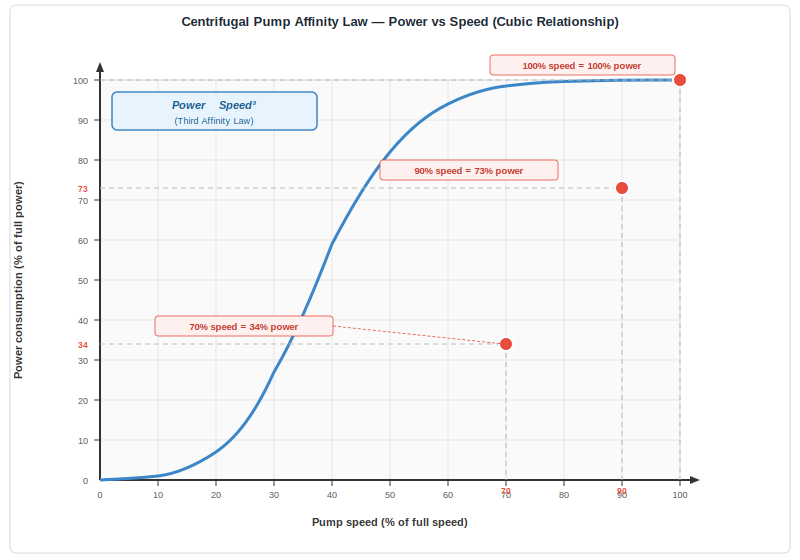
Centrifugal pumps follow affinity laws: power consumption scales with the cube of speed. A pump running at 90% of full speed consumes about 73% of the power it uses at full speed. A pump running at 70% consumes about 34%. The leverage is enormous; small reductions in pump speed deliver large reductions in energy use.
When level control is unreliable, variable speed drives can’t be used aggressively because the control loop isn’t stable. The safe answer is to run faster and accept the energy cost. When the level signal is accurate and the control loop is tight, VFDs can modulate pump speed to precisely match demand. Tanks stay at target levels with minimal overshoot, pumps operate near their best efficiency points, and energy bills reflect the difference.
Beyond VFDs, there’s also the issue of pump start/stop cycling. Inaccurate level sensors lead to high-high and low-low alarms triggering more frequently than they should, causing operators to intervene manually or causing control systems to take drastic corrective actions. Each unnecessary pump start is mechanical wear and an energy spike. Accurate measurement reduces the frequency and severity of these events.
What “High Accuracy” Actually Means in Practice
For pump control optimisation, you don’t necessarily need the most expensive radar transmitter on the market. What you need is a level sensor that is accurate, stable, and reliable in your specific process conditions; one that operators trust enough to let the control system run automatically.
A 0.1% of span transmitter on a 5-metre tank range gives you ±5mm of accuracy. That’s more than adequate for pump control. But a 0.5% transmitter that drifts unpredictably due to coating, condensation, or temperature effects is far more damaging to control loop performance than its spec sheet suggests, because operators will add conservative margins to compensate for the unpredictability.
The question to ask is: does the control system run automatically, or do operators regularly override it? If overrides are frequent, the instruments aren’t trusted. That mistrust has an energy cost.
Calculating the Payback
For a straightforward return on investment calculation: identify your largest pumping loads, find the annual energy cost for those systems, and apply a conservative 10–15% savings estimate for improved level control accuracy. On a site spending $200,000 per year on pumping energy, even a 10% reduction is $20,000 annually; against a transmitter upgrade that might cost $2,000–5,000 per instrument.
Most facilities see payback within 12–18 months on energy savings alone, before accounting for reduced maintenance, fewer pump overhauls, and lower wear on VFDs from reduced cycling.
Frequently Asked Questions
What energy saving is realistic to expect from improving level measurement accuracy? In pump systems where operators are actively adding conservative margins due to instrument mistrust, meaningful reductions in pumping energy are achievable once the measurement is corrected and the control loop is returned to automatic; the more conservative the margins have been, the larger the recovery. In well-run plants where instruments are already trusted and control loops are already tight, the incremental gain from a sensor upgrade is more modest. The largest gains are in facilities where manual operation and conservative setpoints have become the norm because of chronic measurement problems.
Do I need to replace the sensor, or can recalibration solve the problem? It depends on why the measurement is unreliable. Calibration drift alone; where the sensor reads accurately but has shifted over time; is correctable with a recalibration. But if the unreliability is caused by coating on the sensor face, a technology mismatch with the process media (an ultrasonic sensor struggling with foam, a float sensor binding due to viscosity), or a sensing element that has physically degraded, recalibration will not fix the underlying problem. Diagnose the root cause before deciding. A sensor that is fundamentally unsuited to the application will return the same measurement problems regardless of how recently it was calibrated.
Our control loops run in automatic, but operators still adjust setpoints manually. Is that a problem? Yes, it is a subtler version of the same issue. If operators are routinely nudging setpoints higher “just to be safe,” or adjusting manually during certain operating conditions, that behaviour indicates they don’t fully trust the automatic system to handle those conditions. Pull the historian data for setpoint changes over the last six months and look for patterns. Frequent setpoint adjustments tied to specific conditions; certain products, temperatures, or production rates; point to a measurement that is performing inconsistently under those conditions, and that inconsistency has an energy cost.
Key Takeaways for Engineers
Before investing in new instrumentation, audit the control loop performance data you already have. Most DCS and SCADA systems can report the percentage of time a control loop runs in manual versus automatic mode. A level control loop that operators regularly pull into manual; even if only for certain conditions or times of day; is telling you that they don’t trust the measurement enough to leave it in automatic. That data, pulled directly from the historian, is a straightforward business case for instrument improvement, no external benchmarking study required.
Talk to operators before specifying replacements. Operators know exactly which level instruments they trust and which ones they work around. They’ll tell you the east tank transmitter reads low when the ambient temperature drops, or that the mixing vessel always reads high after a batch because foam sits on the surface for twenty minutes. That knowledge, gathered during a single plant walk, identifies precisely where the measurement problems are and what’s causing them. You’ll specify a better solution and avoid replacing instruments that don’t actually need replacing.
When evaluating replacement options, weight measurement stability over headline accuracy. A 0.5% transmitter that holds a consistent, repeatable value week after week is more valuable for pump control than a 0.1% transmitter whose output drifts slightly between maintenance visits. Stable, predictable measurement is what allows operators to trust the automatic control system. Once that trust exists, the control loop tightens, conservative operating margins come down, and the energy savings follow automatically; without anyone needing to change setpoints or override the system. The improvement is structural, not dependent on ongoing manual management.
The Takeaway
Accurate level measurement isn’t just about knowing what’s in your tank. It’s the foundation that allows your control system to operate confidently and efficiently. When the measurement is trusted, the control loop can be tight, VFDs can modulate properly, and pumps run only as hard as the process demands. The energy savings are a direct consequence of getting the instrumentation right.