Why Foam Is a Level Measurement Problem
Foaming occurs in a wide range of industrial processes. In pulp and paper mills, the black liquor from chemical pulping froths heavily. Fermentation tanks in breweries and distilleries generate significant CO₂-driven foam. Chemical reactors involving surfactants, proteins, or aerated liquids develop foam layers as part of normal operation. Wastewater treatment aeration basins are intentionally foamy.
The challenge foam creates for level measurement is that it occupies physical space in the tank without being liquid. Foam density is typically in the range of 50–300 kg/m³ — far below liquid density of around 1,000 kg/m³ for water-based products, or 700–900 kg/m³ for hydrocarbon liquids. A 500mm foam layer sitting above 2 metres of liquid represents a real risk of measurement error if the sensor cannot distinguish between the two phases.
The consequences depend on the process. In a storage tank, an operator who sees a level reading of 2.5 metres and does not know 500mm of that is foam has an incorrect view of actual liquid inventory. In a reactor where fill volume affects reaction yield, foam confusion leads to product quality problems. In a tank approaching overflow protection, a sensor that reads the foam surface as the liquid surface may fail to trigger an alarm until actual liquid is at the overflow point — by which time the foam is already overflowing.
How Common Technologies Fail With Foam
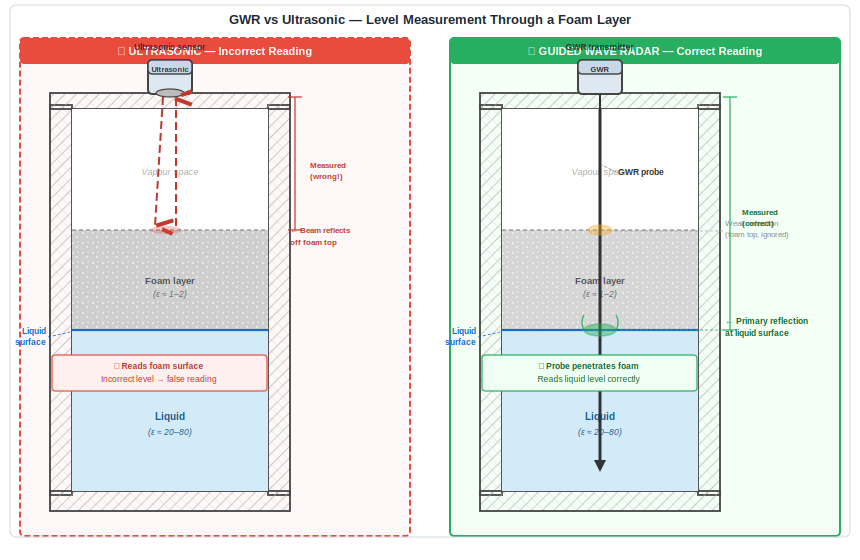
Ultrasonic sensors transmit sound pulses and measure the echo from the material surface. Sound energy does not penetrate foam effectively — it reflects from the foam top. The ultrasonic sensor reads the foam surface, not the liquid level. In variable-foam applications, the measurement varies with foam height rather than liquid height. The two cannot be distinguished without additional information.
Float-based sensors physically float on the surface of the liquid. In a foamy tank, the float can ride on the foam layer, being supported by the foam rather than the liquid. Foam that subsequently collapses dumps the float rapidly, creating false high-to-low level transitions. Mechanical fouling of the float body and cable by foam residue is also common in sticky or protein-laden foam environments.
Free-space radar at lower frequencies (6 GHz, 26 GHz) can also reflect from foam layers, depending on the foam’s dielectric properties. Dense wet foam with a higher water content can have a relative permittivity (dielectric constant) high enough to produce a radar reflection. In processes with variable foam density, the radar reflection may sometimes come from the foam surface and sometimes penetrate to the liquid — making the measurement unpredictable.
Guided Wave Radar — Measuring Through the Foam
Guided wave radar (GWR) transmitters work on a fundamentally different principle from free-space radar. Instead of transmitting an unguided beam through the air, GWR guides the microwave energy along a probe — typically a rigid rod, flexible cable, or coaxial tube — that extends from the transmitter at the top of the tank down through the process contents to near the tank floor.
The microwave signal travels along the probe and reflects at boundaries where the dielectric constant changes. Foam has a significantly lower dielectric constant than liquid — typically in the range of 1.0–2.0 for many foams, compared to values of 5–80 for the liquid phase in common industrial applications (water-based liquids typically have dielectric constants of 20–80; hydrocarbons typically 2–5). The GWR algorithm is designed to identify and locate these dielectric transitions along the probe.
This means a GWR transmitter can distinguish between the foam surface (lower dielectric, weaker reflection) and the liquid surface beneath (higher dielectric, stronger reflection). Modern GWR transmitters with dual-output capability can simultaneously report both the foam top level and the liquid surface level as separate measurements — giving operators complete visibility into tank conditions: total fill height including foam, actual liquid level, and by subtraction, foam layer thickness.
GWR Probe Selection for Foam Applications
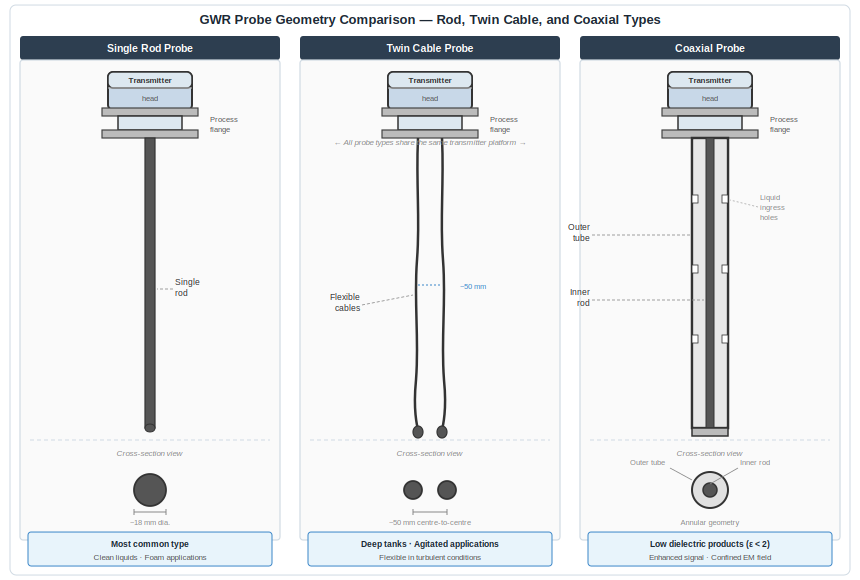
The probe type and geometry affect GWR performance in foamy applications:
Single rigid rod probes are the most common choice for tanks with moderate foam. They provide reliable liquid level measurement in most applications and are easy to clean. For very light, low-density foam (dielectric close to 1.0), the single rod may not produce a strong foam reflection — which is actually acceptable if the application only requires accurate liquid level, not foam level.
Coaxial probes enclose the rod within a tube, creating a defined measurement geometry that is less affected by the surrounding media. In applications where the liquid itself has a low dielectric constant (light hydrocarbons, for example), the coaxial geometry provides stronger reflections than a rod probe. However, coaxial probes can become blocked by foam residue or product buildup in sticky applications.
Twin flexible cable probes are suited for deep tanks where a rigid rod would be impractical, or for tanks with agitation that would mechanically stress a rigid probe. The flexible cable can accommodate some lateral movement without damage.
Practical Considerations and Limitations
GWR requires a probe that extends through the full measurement range into the liquid. In tanks with agitators, the probe must be positioned to avoid contact with the agitator — either by routing it in a protected corner or by using a guide at the bottom to maintain the probe position. Tanks with very heavy product buildup (sticky polymers, asphalt-like materials) may coat the probe over time, requiring periodic cleaning.
For applications where the foam layer is extremely thick — more than a metre or two — the GWR transmitter must have sufficient probe length to reach below the foam into the liquid in all operating conditions. Probe lengths of 3–6 metres are common in tall tanks; custom lengths are available from most manufacturers for specific applications.
The Bottom Line
If your process generates foam and you rely on ultrasonic, free-space radar, or float-based level measurement, there is a real probability that your level readings are tracking the foam surface rather than the liquid level — particularly during process upsets when foam is heaviest and accurate level information is most critical.
Guided wave radar is the most reliable technology for accurate liquid level measurement in foamy processes. The combination of probe-guided signal propagation and dielectric discrimination gives it capabilities that free-space technologies simply cannot replicate in environments where the surface you’re trying to measure is obscured by foam.